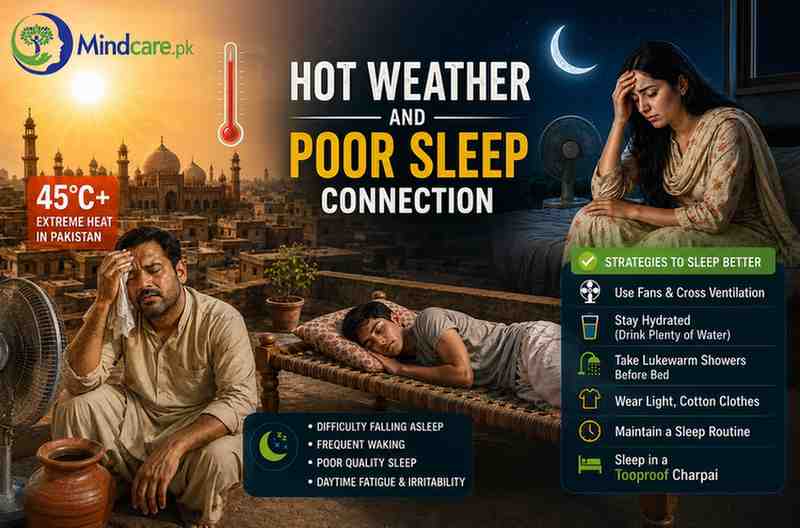
Hot Weather and Poor Sleep Connection: Practical Strategies to Sleep Better During Pakistan's Hot Summers
Pakistan's summers are becoming hotter every year. In-fact, tolerating the daytime heat is only half the battle. When night arrives, bedrooms remain uncomfortably warm, electricity outages interrupt fans and air conditioners, and restful sleep becomes
difficult.
While most people think of poor sleep as a minor inconvenience, research tells a different story. Hot nights don't just leave you tired—they affect your mood, concentration, emotional resilience, and overall mental health.
At MindCare.pk, we believe that good sleep is essential for psychological well-being. Understanding how heat affects sleep—and learning practical ways to stay cool—can help you and your family sleep better during Pakistan's long summer
season.
Why Does Hot Weather Make It Hard to Sleep?
Falling asleep depends on your body's ability to lower its core temperature by about 1°C. This natural cooling signals the brain that it is time to sleep.
When your bedroom stays hot, your body struggles to lose heat. Instead of relaxing into sleep, it continues trying to cool itself by sweating and increasing blood flow to the skin. As a result, you may:
- Take longer to fall asleep
- Wake repeatedly during the night
- Experience lighter, less refreshing sleep
- Wake up feeling tired despite spending enough time in bed
🔬 Research Insight
A 2025 study published in Nature Communications analyzed more than 23 million nights of objectively measured sleep from over 214,000 people. Researchers found that for every 10°C increase in average temperature,
the odds of getting insufficient sleep increased by approximately 20%, sleep duration decreased by about 10 minutes, and deep sleep—the stage most important for physical recovery and emotional regulation—declined the most.
Similarly, a 2024 systematic review in Sleep Medicine Reviews concluded that higher night time temperatures consistently reduce both sleep quality and sleep duration across different populations.
Hot nights don't just feel uncomfortable—they genuinely interfere with your brain's ability to achieve good sleep.
The Sleep–Mood Connection
Poor sleep doesn't end when you wake up.
After a restless night, you are more likely to experience:
- Irritability
- Difficulty concentrating
- Reduced patience
- Poor decision-making
- Low motivation
- Increased stress
When poor sleep continues for several days or weeks, these effects become even more noticeable.
Research shows that chronic sleep deprivation increases the risk of:
- Anxiety
- Depression
- Burnout
- Emotional exhaustion
- heart diseases
- Alzheimer's disease
Heat itself also affects mood. When hot weather and poor sleep occur together—as they often do during Pakistan's summers—their effects compound, making daily life significantly more stressful. (For coping with the heat itself, see our psychological tactics to build heat resilience.)
🔬 Research Insight
Scientists increasingly recognize sleep disruption as one of the key ways climate change affects mental health. Losing restorative sleep reduces emotional regulation and increases vulnerability to stress, anxiety and other health
related problems.
Pakistan's Unique Challenge: Hot Nights and Load Shedding
Many countries experience hot weather.
Pakistan faces an additional challenge: night-time electricity outages.
During summer, electricity demand often exceeds supply, leading to scheduled and unscheduled load shedding. Unfortunately, these outages frequently occur during the evening and night—the exact time when fans and air conditioners are needed most.
For millions of households without:
- UPS systems
- Solar backup
- Generators
the room quickly becomes hot and stuffy, making sleep extremely difficult. City dwellers face added pressures too—we've covered sleep problems in urban Pakistan and their solutions in detail.
This creates a frustrating cycle:
Extreme heat → Power outage → Poor sleep → Fatigue → Irritability → Lower productivity → More stress
Breaking this cycle begins with understanding how to reduce heat exposure before bedtime.
10 Practical Strategies to Sleep Better During Pakistan's Summers
Although you cannot control the weather or the electricity supply, you can make several small changes that significantly improve sleep quality.
1. Pre-Cool Your Bedroom
If load shedding is scheduled, run your fan or air conditioner 20–30 minutes before the outage.
Cooling the room in advance helps maintain a lower temperature after the electricity goes out.
2. Improve Airflow
Open windows on opposite sides of the room whenever it is safe to do so.
Place your fan near one window to pull cooler night air through the room rather than simply circulating warm indoor air.
🔬 Research Insight
Research published in Scientific Reports (2024) found that passive cooling methods such as natural ventilation and improved airflow can noticeably improve sleep comfort while reducing dependence on air conditioning.
3. Try the Wet-Cloth Cooling Method
This is a simple and traditional technique which is need of time.
Place a damp cloth or thin wet sheet in front of a running fan. As the water evaporates, it cools the surrounding air naturally—a useful option during power outages.
4. Choose Breathable Cotton Bedding
Wear lightweight cotton clothing and use cotton bedsheets. Cotton allows sweat to evaporate efficiently, helping regulate body temperature better than many synthetic fabrics.
5. Cool Your Body Before Bed
Take a lukewarm shower about 20–30 minutes before bedtime.
Research suggests that a lukewarm shower (water that is neither hot nor cold)is the most effective way to cool off on a hot day. Exposing your body to extreme cold can cause blood vessels to constrict (trapping heat), whereas lukewarm water safely
brings blood to the surface to release excess warmth.
6. Sleep on the Rooftop (When Safe)
Traditional rooftop sleeping on a charpai remains one of Pakistan's most effective low-cost cooling strategies.
If your surroundings are safe:
- Use mosquito protection.
- Stay hydrated.
- Avoid direct morning sunlight.
Fresh outdoor air often cools more quickly than enclosed rooms.
7. Keep a Rechargeable Fan Ready
Charge your rechargeable fan before bedtime so you're prepared for unexpected electricity outages. Even gentle airflow can make a noticeable difference.
8. Reduce Screen Time Before Bed
Avoid phones, tablets, and television for 30–45 minutes before sleeping.
Blue light suppresses melatonin—the hormone that helps regulate your sleep cycle. contrarily, spend a few quiet minutes reading, praying, or relaxing.
9. Nap Smart
If poor sleep leaves you exhausted, take a 20-minute afternoon nap. But, avoid longer naps, which can make it harder to fall asleep the following night.
10. Calm Your Mind Before Bed
Heat keeps not only the body but also the nervous system alert.
Spend five to ten minutes in Diaphragmatic Breathing: Focus on breathing deep into your belly. Inhale for a slow count of 4 seconds, and exhale for 6 to 8 seconds to trigger your nervous system's natural relaxation response
This technique help your brain transition into restful sleep.
🔬 Research Insight
Clinical research consistently shows that relaxation techniques reduce physiological arousal, making it easier to fall asleep—even when environmental conditions are less than ideal.
When Should You Seek Professional Help?
Occasional sleep problems during a heatwave are normal.
However, you should consider seeking professional support if:
- Sleep problems continue for several weeks.
- Anxiety keeps you awake most nights.
- You constantly feel exhausted despite adequate time in bed.
- Low mood, irritability, or stress begin affecting work, studies, or relationships.
Persistent sleep problems can contribute to anxiety and depression if left untreated. Professional sleep therapy and insomnia treatment can help you restore healthy, restful sleep.
Final Thoughts
Hot nights and poor sleep are no longer just seasonal inconveniences in Pakistan. Rising temperatures, humid weather, and frequent load shedding create a cycle of sleep deprivation that affects physical health, emotional well-being, and mental
resilience.
The good news is that small changes—cooling your room before bedtime, improving airflow, choosing breathable bedding, limiting screen time, and practicing relaxation techniques—can make a meaningful difference.
If stress, anxiety, or poor sleep continues even after the weather improves, remember that you don't have to manage it alone.
MindCare.pk Can Help
At MindCare.pk, our licensed psychologists provide confidential online therapy for mental health issues linked with poor sleep.
We offer secure chat, audio, and video consultations in English and Urdu, allowing you to access professional mental health care from the comfort of your home. Book an online session to get started.
Sleep isn't a reward for surviving a hot day—it's how your mind and body recover from one. This summer, prioritize your sleep and protect your mental well-being.
References
Chevance, G., Minor, K., Vielma, C., et al. (2024). A systematic review of ambient heat and sleep in a warming climate. Sleep Medicine Reviews, 75, 101915.
Li, A., Luo, H., Zhu, Y., et al. (2025). Climate warming may undermine sleep duration and quality in repeated-measure study of 23 million records. Nature Communications.
Aijazi, A., Parkinson, T., Zhang, H., et al. (2024). Passive and low-energy strategies to improve sleep thermal comfort and energy resilience during heat waves and cold snaps. Scientific Reports.