MindCare Pakistan offers convenient and affordable online therapy, connecting you with licensed therapists from the comfort of your own home. Find support for anxiety, depression, relationships, and more.
Connect with a qualified psychologist online from the convenience of your home in Pakistan.
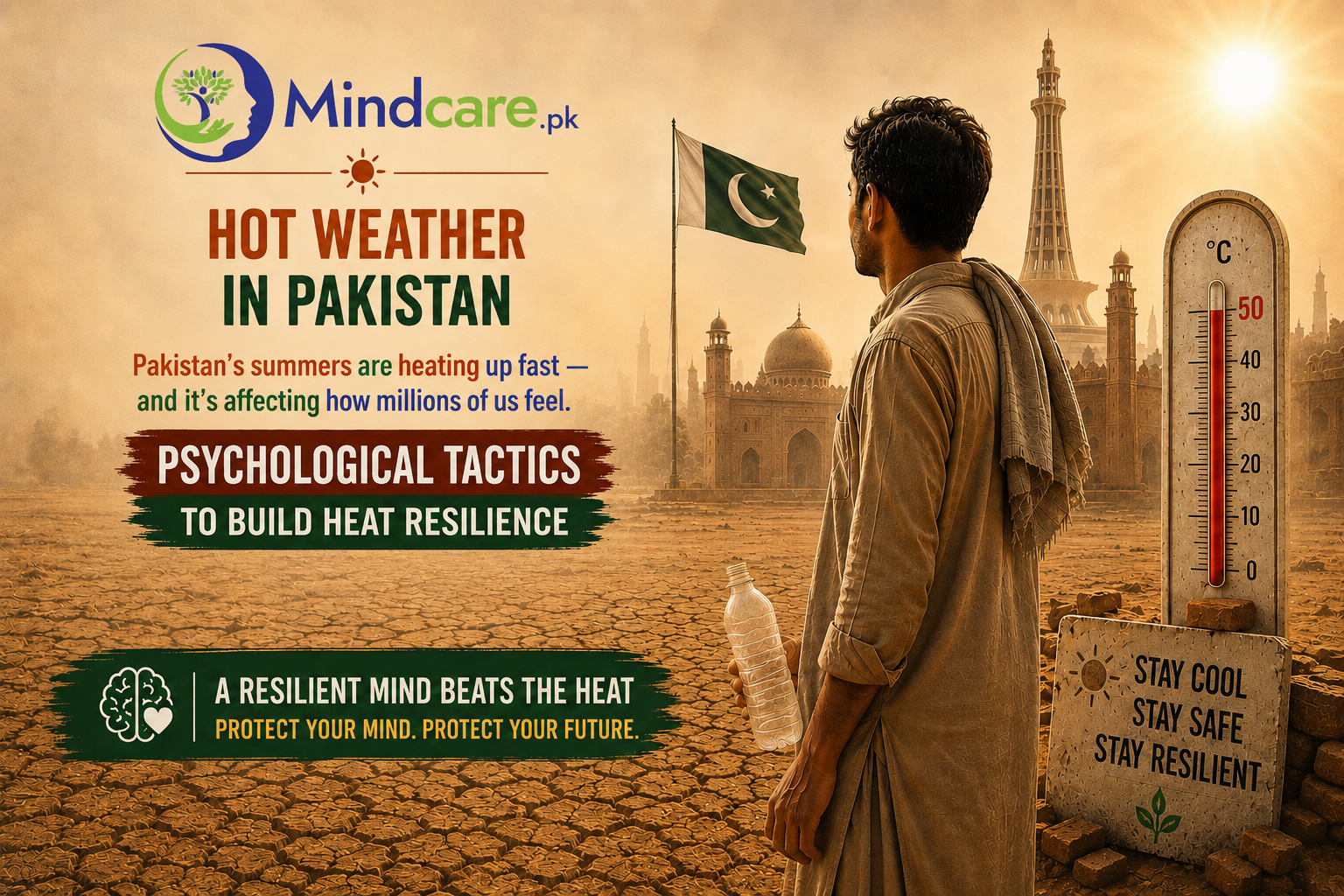
Hot Weather in Pakistan: Psychological Tactics to Build Heat Resilience
Pakistan's summers are no longer just uncomfortable — they're rewiring how millions of us feel, think, and cope. Here's what's happening, and how to build real resilience against it.
CALM
OVERWHELMED
It's not just you. If summers in Lahore, Karachi, Jacobabad, or Multan feel more brutal every year, that's because they are — and the heat isn't only settling into our bodies. It's settling into our minds too.
01Pakistan Is on the Front Lines
Pakistan contributes very little to global carbon emissions, yet it consistently ranks among the countries most affected by climate change. Between 1998 and 2018 alone, the country faced over 150 extreme weather events.
In recent years, pre-monsoon heatwaves have pushed temperatures past 46°C in multiple cities, with scientists confirming that climate change has made these
deadly heat spells several times more likely — and that what used to be rare extreme heat is now becoming a regular part of our summers.
This isn't a distant, abstract threat. It's showing up in our streets, our homes, and increasingly, in how we feel.
02The Heat–Mind Connection
We tend to think of heat as a physical problem — sunstroke, fatigue, dehydration. But research is increasingly clear that extreme heat also affects mood, thinking, and emotional regulation. When the body is under constant thermal stress, sleep suffers,
the nervous system stays on high alert, and irritability, anxiety, and exhaustion become the norm rather than the exception. (We've explored the global psychological risks of climate change in more depth.)
For many Pakistanis already living with financial stress, unreliable electricity, and packed, poorly ventilated homes, heatwaves don't just make life uncomfortable — they push already stretched coping systems past their limit. Researchers studying
young adults in rural Punjab and women in Khyber Pakhtunkhwa's Malakand region have both found the same pattern: rising temperatures are linked to increased stress, anxiety, and emotional
strain, especially in communities with the fewest resources to cope.
Not just physicalRising body temperature keeps the nervous system on high alert — which is why heat so often
shows up as a short temper or racing thoughts, not just sweat.
03Who Feels It Most
Outdoor Workers
Can't step away from the heat — facing both physical danger and unstable, weather-dependent income.
Rural Women
Manage water scarcity, cooking without ventilation, and caregiving — absorbing the day-to-day burden.
Children & Elderly
Physically vulnerable, and prone to disrupted routines and family stress during extreme heat.
Displaced Families
Carry the added weight of lost homes and uncertain futures after floods or drought.
Exposure adds upFor outdoor workers and rural families, there's often no option to simply stay indoors —
so the physical and emotional toll of heat accumulates, day after day.
When minds are not safe, society itself cannot remain safe.
04A System Already Stretched Thin
With fewer than 600 psychiatrists for a population of over 240 million, most based in major cities, millions of people in climate-affected areas have nowhere
to turn once the immediate crisis passes. The disaster ends, but the psychological aftershocks often don't — showing up as trouble sleeping, snapping at loved ones more easily, dread before summer even begins, or a quiet hopelessness that's easy
to dismiss as "just the heat."
05Your Heat Resilience Toolkit
Big fixes — green cover, early warning systems, accessible healthcare — take policy and time. But here's the good news: the mind can be trained to handle heat stress better, starting today, with no special equipment or budget.
Think of the ten tactics below less like a checklist and more like a toolbox. You don't need all ten at once — pick one or two that fit your day, try them the next time the heat starts pressing on your mood, and build from there. Each one is small,
practical, and grounded in how the mind actually responds to stress.
Reframe
Separate the sensation from the alarm
Heat triggers a threat response even when you're safe. Try a quiet script: "I'm hot and uncomfortable, but I am not in danger right now." Naming the feeling without catastrophizing it lowers the emotional spike that turns discomfort into panic.
Breathe
Use slow breathing to cool your nervous system
Heat keeps the body in fight-or-flight mode. Box breathing — inhale 4 counts, hold 4, exhale 4, hold 4 — activates the parasympathetic system and can measurably reduce the irritability and racing thoughts that heat brings on.
Ground
Interrupt heat-driven anxiety spikes
When heat-fueled anxiety hits, try the 5-4-3-2-1 method: name 5 things you see, 4 you feel, 3 you hear, 2 you smell, 1 you taste. It pulls attention out of spiraling thoughts and back into the present moment.
Anchor
Build a "cooling ritual"
Pair a small physical action — cold water on your wrists, a damp cloth on your neck — with a consistent calming phrase or breath. Repeated often enough, the ritual itself becomes a trigger for calm, not just cooling.
Schedule
Protect your sense of control
Heat often steals structure from the day. Anchor essential tasks, movement, or errands to the coolest hours you have, and treat that schedule as non-negotiable. Predictability itself lowers stress, even when the weather won't cooperate.
Limit
Ration your climate news intake
Constant exposure to heatwave news and climate doom feeds eco-anxiety without giving you anything actionable to do with it. Check updates once or twice a day from a reliable source, then step away.
Connect
Don't carry it alone
Heat-related stress isolates people just when they need support most. A short check-in with a neighbor, friend, or family member — even just naming how the heat is affecting you — reduces the isolation that turns stress into something heavier.
Act
Turn helplessness into a small action
Eco-anxiety often comes from feeling powerless. Channel it into something concrete and local — planting a shade tree, conserving water, checking on a vulnerable neighbor. Agency, even in small doses, is a genuine antidote to dread.
Rest
Protect sleep like it's medicine
Heat is one of the biggest sleep disruptors, and poor sleep quietly worsens anxiety and low mood. Cool your sleeping space where you can, hydrate through the day rather than right before bed, and keep a wind-down routine even when it's sweltering.
For a full guide, see our practical strategies to sleep better during Pakistan's hot summers.
Forgive
Be gentle with reduced capacity
You will likely get less done, think a little slower, and feel more depleted during extreme heat — that's physiology, not failure. Lowering your expectations of yourself during a heatwave is a form of self-care, not giving up.
06Final Thoughts
Heat and mental health are not two separate stories in Pakistan — they're one and the same. The same summer that pushes the mercury past 46°C is also the one that pushes our patience, our sleep, and our sense of calm to their limits. Recognizing
that connection — that a bad heat season can genuinely be a mental health event, not just a physical one — is the first step toward taking it seriously.
The tactics in this article can help you get through these hard day. However, professional support is also available.