
MindCare Pakistan offers convenient and affordable online therapy, connecting you with licensed therapists from the comfort of your own home. Find support for anxiety, depression, relationships, and more.

Connect with a qualified psychologist online from the convenience of your home in Pakistan.

Book Appointment
Address

Islamabad, Pakistan
Professional Support for Better Sleep

Online Insomnia Therapy & Sleep Support

When Trying Harder to Sleep Seems to Make Sleep Even Harder.

Difficulty sleeping can become more than an occasional bad night. You may spend hours trying to fall asleep, wake repeatedly, wake much earlier than intended, or lie in bed worrying about how exhausted you will feel the next day.

Psychological therapy can help you understand the patterns that may be keeping insomnia going and develop evidence-based strategies for changing your relationship with sleep.

Book an Appointment
✓ Private Online Sessions✓ Professional Psychological Support✓ Accessible Wherever You Are
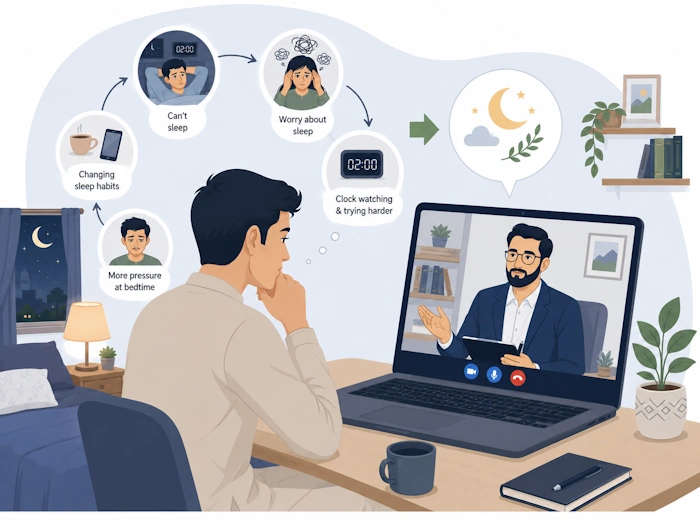
patient receiving online support for insomnia and sleep difficulties
The Insomnia Cycle

Why Can Sleep Become Harder the More You Worry About It?

A few difficult nights may begin because of stress, a change in routine, travel, illness, emotional distress, or another disruption. But sometimes the original trigger passes while the sleep problem continues.

After repeated poor nights, bedtime itself can become associated with effort and worry. You may start watching the clock, calculating how many hours remain, going to bed unusually early, staying in bed longer to “catch up,” or worrying throughout the day about whether you will sleep that night.

These reactions are understandable, but some can unintentionally strengthen the cycle of sleeplessness and sleep-related anxiety. Therapy for insomnia focuses on understanding your individual pattern rather than simply telling you to “relax” or practise generic sleep hygiene.

A Familiar Pattern?

  • “I feel tired all day, then suddenly alert when I get into bed.”
  • “I keep checking the time and calculating how little sleep I will get.”
  • “One bad night makes me anxious about the next one.”
  • “I spend more time in bed hoping I can catch up on sleep.”
  • “My mind becomes busiest exactly when I need to sleep.”
More Than Feeling Tired

How Persistent Sleep Difficulties Can Affect Daily Life

Poor sleep can affect how you function and how you feel about the coming night. The experience differs from person to person.

Night-Time Struggle

Difficulty falling asleep, repeated waking, waking too early, or feeling that sleep is light and unsatisfying.

Daytime Fatigue

Low energy, irritability, reduced motivation, or finding ordinary responsibilities more demanding.

Focus & Mood

Concentration may feel harder, while frustration and worry about sleep can occupy more of your attention.

Sleep-Related Worry

Bedtime can become something you anticipate anxiously instead of a natural transition into rest.

Evidence-Based Psychological Treatment

What Is CBT-I?

Cognitive Behavioural Therapy for Insomnia (CBT-I) is a structured psychological approach developed specifically for persistent insomnia. It looks at the interaction between sleep patterns, behaviours, thoughts, expectations, and the body's sleep-wake system.

CBT-I is more than a list of “sleep hygiene” tips. The exact approach should be tailored to your circumstances and guided by an appropriately trained professional.

Therapy May Explore Several Parts of the Sleep Pattern

  • Sleep patterns: understanding when you sleep, wake, nap, and spend time in bed.
  • Learned associations: helping the bed and bedroom become more strongly associated with sleep rather than wakefulness and frustration.
  • Sleep-related thoughts: examining worry, predictions, and pressure around the consequences of not sleeping.
  • Time in bed: where clinically appropriate, structured changes may be used to consolidate sleep and improve sleep efficiency.
  • Relaxation and arousal: developing ways to respond to physical tension and a busy mind.
  • Healthy sleep habits: considering routines, light, activity, caffeine, and other factors relevant to your sleep.
Before Assuming It Is “Just Insomnia”

Not Every Sleep Problem Has the Same Cause

Sleep difficulties can occur alongside stress, anxiety, depression, changes in routine, physical health conditions, medications, or other sleep disorders. Psychological therapy can be useful for insomnia, but it should not be presented as the answer to every kind of sleep problem.

If your symptoms suggest another medical or sleep condition, an appropriate medical assessment may be important alongside or before psychological treatment.

Consider Medical Assessment If Relevant

Speak with an appropriate healthcare professional if you have concerns such as loud persistent snoring with pauses in breathing or choking during sleep, unusual movements or behaviours during sleep, significant unexplained daytime sleepiness, or another health issue that may be affecting sleep.

A psychologist can also discuss whether your sleep difficulties appear connected with anxiety, low mood, stress, trauma, or other psychological concerns that may need attention as part of treatment.

Your First Sessions

Understanding Your Sleep Before Trying to Change It

Your psychologist may ask when the problem began, what a typical night looks like, your sleep and wake times, daytime routines, naps, caffeine use, stress, health factors, and what you currently do when you cannot sleep.

You may be asked to keep a sleep diary for a period of time. This can reveal patterns that are difficult to see when every night feels unpredictable.

Therapy Is Not About Achieving “Perfect” Sleep

Trying to control every minute of sleep can itself become part of the pressure surrounding bedtime. Treatment generally focuses on building a more stable and workable sleep pattern, reducing behaviours and thoughts that perpetuate insomnia, and helping you respond differently when a difficult night occurs.

Progress is individual. Rather than promising a particular result within a fixed number of sessions, your psychologist can review your sleep pattern, goals, response to treatment, and whether another type of assessment or support is needed.

Has Sleep Become Something You Spend the Whole Day Worrying About?

Professional support can help you understand the pattern and work toward a healthier relationship with sleep.

Accessible Wherever You Are

Online Insomnia Therapy for Pakistanis at Home and Abroad

Online sessions can make psychological support easier to fit around work, study, parenting, travel, or life in a different time zone. This can be particularly useful when regular local access to appropriate psychological support is limited.

For Pakistanis living locally or overseas, therapy can also consider routines shaped by family life, work schedules, shared households, cultural practices, and other circumstances relevant to your sleep—without assuming that the same advice fits everyone.

  • Private sessions from a convenient location
  • Support for sleep-related thoughts, behaviours, and routines
  • Accessible for Pakistanis locally and abroad, subject to professional requirements
FAQ & Answers

Common Questions About Insomnia Therapy

You do not need to wait for sleep problems to become severe before discussing them with a professional. Consider seeking help when difficulty sleeping persists, causes significant distress, affects daytime functioning, or when worry about sleep begins to shape your routines and behaviour.

No. Healthy sleep habits may form one part of treatment, but CBT-I is a broader structured approach that addresses behavioural patterns, sleep-related thoughts and expectations, learned associations with the bed and bedroom, and other factors that can maintain insomnia.

Psychological support for insomnia, including elements of CBT-I when appropriate, can be delivered online. Suitability depends on your individual symptoms, circumstances, the professional's training, and whether another medical or sleep assessment is needed.

Treatment choices should be discussed with an appropriate healthcare professional rather than treating therapy and medication as a simple either-or choice. CBT-I is commonly recommended as a first-line treatment for chronic insomnia, while medication decisions depend on individual circumstances and should be made with a qualified prescriber.

The duration varies according to the approach, your sleep pattern, other concerns, and how you respond. Your psychologist can discuss a treatment plan and review progress rather than promising improvement within a fixed number of sessions.

Yes, psychological treatment can explore both insomnia patterns and the anxiety or stress that may contribute to nighttime arousal. The appropriate focus depends on whether insomnia is the main concern or part of a broader psychological difficulty.