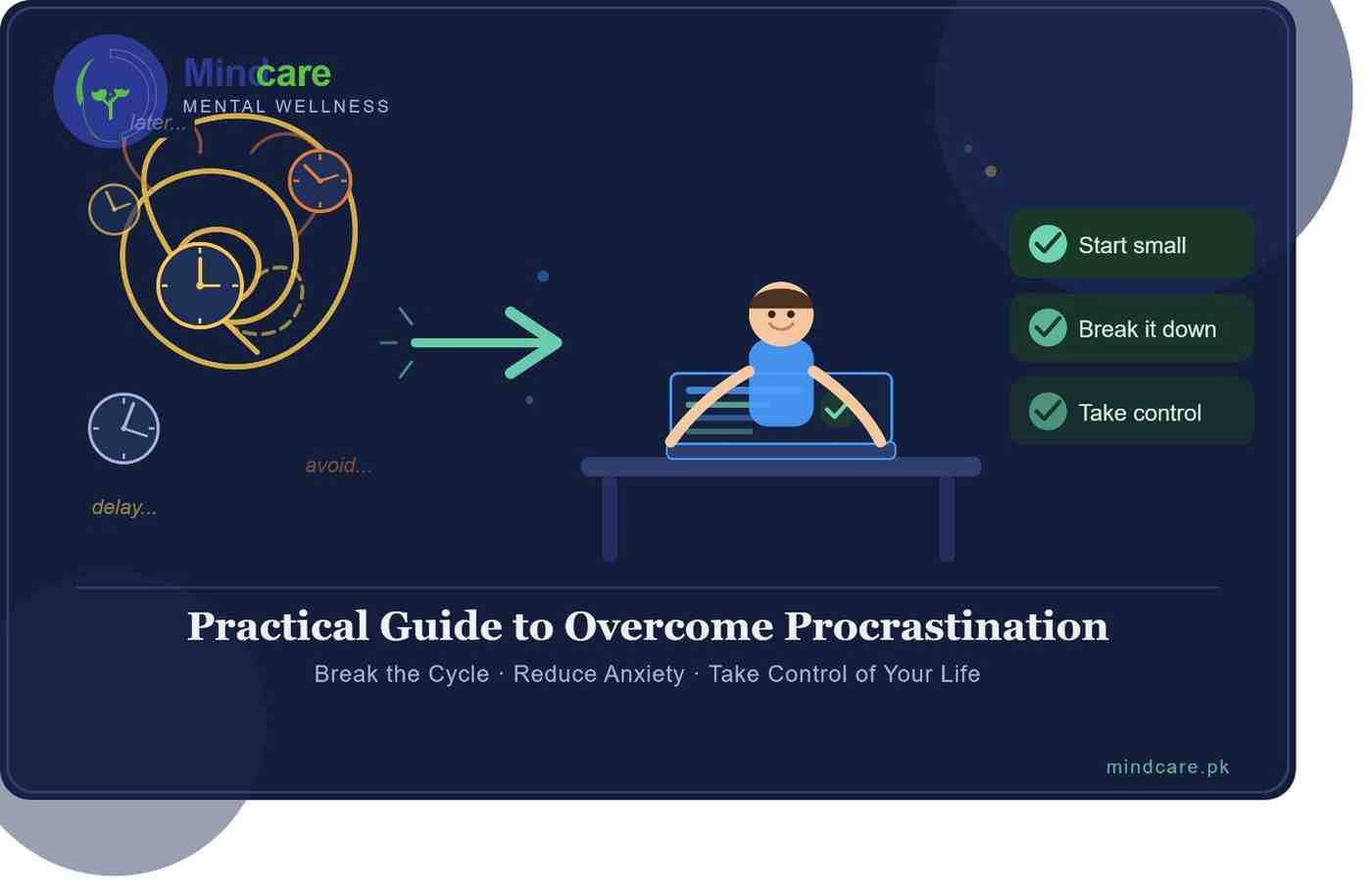
Practical Guide to Overcome Procrastination: Break the Cycle of Delay, Reduce Anxiety, and Take Control of Your Life
"I'll start tomorrow."
If this sentence sounds familiar, you're not alone.
Many students, professionals, freelancers, and even homemakers struggle with procrastination. They delay studying, postpone assignments, avoid difficult conversations, or keep putting off important decisions. At first, it feels like harmless postponement.
But over time, procrastination creates stress, guilt, anxiety, low confidence, and missed opportunities. Procrastination is
one of the most misunderstood mental habits of our time. It's not a character flaw. It's not a sign you don't care. Most of the time, it's a signal that something deeper is going on — fear, anxiety, perfectionism, or simply an overwhelmed mind that
doesn't know where to begin.
This guide is here to help you understand why you procrastinate, and give you real, practical tools to break the cycle — gently and sustainably.
First, Let's Understand Why We Procrastinate
Before we fix the problem, we need to understand it. Procrastination isn't really about time management. Research increasingly shows it's about emotion management.
When a task feels:
- Too big or overwhelming
- Connected to fear of failure or judgment
- Boring or meaningless
- Linked to perfectionism ("I'll start when I feel ready")
...our brain's automatic response is to avoid it. We reach for something easier, more comfortable, or more stimulating. The avoidance gives us temporary relief — but the guilt and anxiety that follow only make the task feel more daunting
the next time we face it.
This is the procrastination loop:
Task feels hard → Avoid it → Feel relief (briefly) → Feel guilty → Task feels even harder → Avoid again
Understanding this cycle is the first step to escaping it.
The Anxiety-Procrastination Connection
Here's something important that many people don't realize: procrastination and anxiety feed each other.
When we delay tasks, we don't actually escape the stress — we just shift it. The unfinished task sits in the back of our mind, quietly draining our energy and attention. Over time, this builds into a heavier feeling of dread, making it even harder to
start.
If you've ever noticed that your anxiety spikes as a deadline approaches, or that you feel physically tense even thinking about a task you've been avoiding — that's the anxiety-procrastination cycle in action.
The good news? When you take even a small step forward, that cycle can reverse. Action reduces anxiety. Not the other way around.
Practical Strategies to Overcome Procrastination
1. Use the Two-Minute Rule
If a task takes less than two minutes:
Do it immediately.
Examples:
-
Reply to an email.
-
Wash your cup.
-
Open your notebook.
-
Organize your desk.
Starting builds momentum.
2. Make Tasks Ridiculously Small
Instead of:
❌ Write my assignment
Try:
✔ Open Microsoft Word.
✔ Write one sentence.
✔ Create headings.
Small wins reduce resistance.
3. Focus on Starting, Not Finishing
Tell yourself:
"I only have to work for five minutes."
Once you begin, your brain often continues naturally.
Starting is usually the hardest part.
4. Use the Pomodoro Technique
Work:
25 minutes
Take a break:
5 minutes
Repeat four times.
This technique prevents mental exhaustion while improving focus.
5. Remove Distractions
Your environment matters.
Practical ideas include:
-
Keep your phone in another room.
-
Turn off notifications.
-
Use website blockers.
-
Keep only necessary study materials on your desk.
A distraction-free environment reduces the need for willpower.
6. Stop Waiting for Motivation
Many people think:
"I'll start when I feel motivated."
Psychology shows the opposite.
Action creates motivation.
Start first.
Motivation follows. (Waiting for motivation is also one of the 10 micro habits that quietly fuel depression.)
7. Challenge Negative Thoughts
Notice thoughts like:
"I'm going to fail."
Replace them with:
"I don't need perfection. I only need progress."
Healthy thinking reduces avoidance.
8. Practice Self-Compassion
Many procrastinators constantly criticize themselves.
They say:
"I'm useless."
"I'm lazy."
"I'll never change."
Research shows that self-compassion improves motivation far more than self-criticism.
Speak to yourself like you would speak to a good friend.
9. Create Daily Priorities
Instead of a long to-do list, write:
Today's Top 3 Tasks
When priorities are clear, decision fatigue decreases.
10. Reward Yourself
After completing a task:
-
Drink your favorite tea.
-
Watch one episode.
-
Take a walk.
-
Listen to music.
Positive reinforcement helps build productive habits.
Managing Anxiety While Working
When anxiety feels overwhelming:
Practice Deep Breathing
Inhale for four seconds.
Hold for four seconds.
Exhale for six seconds.
Repeat several times. (Learn the full technique in our guide to diaphragmatic breathing to calm anxiety and panic.)
Ground Yourself
Notice:
-
Five things you can see
-
Four things you can touch
-
Three things you can hear
-
Two things you can smell
-
One thing you can taste
This simple grounding exercise helps reduce anxious thoughts.
Accept Imperfection
Progress is better than perfection.
A completed task is almost always more valuable than a perfect task that never gets finished.
Build Better Habits
Consistency matters more than intensity.
Small daily habits create lasting change.
Examples:
-
Read 10 pages daily.
-
Exercise for 15 minutes.
-
Study for 25 minutes.
-
Sleep at a consistent time.
-
Reduce screen time before bed.
Small improvements accumulate over time.
When Procrastination Becomes Something More
Sometimes persistent avoidance isn't just a bad habit — it can be a sign of something deeper, like:
- Chronic anxiety or depression, which drain motivation and make the simplest tasks feel impossible
- ADHD, which affects attention regulation and executive function
- Burnout, which leaves you depleted and unable to engage
If you find that procrastination is significantly affecting your work, relationships, or wellbeing — even when you try the strategies above — it may be worth speaking to a mental health professional.
At MindCare.pk, we work with individuals who struggle with anxiety, low motivation, and patterns that feel impossible to break on their own. You don't have to figure this out alone.
A Final Word: Progress, Not Perfection
Breaking the procrastination habit doesn't happen overnight. There will be days when you avoid, delay, and spiral — and that's okay. What matters is that you notice the pattern, treat yourself with kindness, and take one small step forward.
You don't need to do it all today. You just need to do something.
Start small. Start imperfect. Start now.
If you found this helpful, explore more mental wellness resources at MindCare.pk. Our team of trained professionals is here to support you on your journey toward clarity, calm, and confidence.
📩 Reach out to us at mindcare.pk to book a consultation.