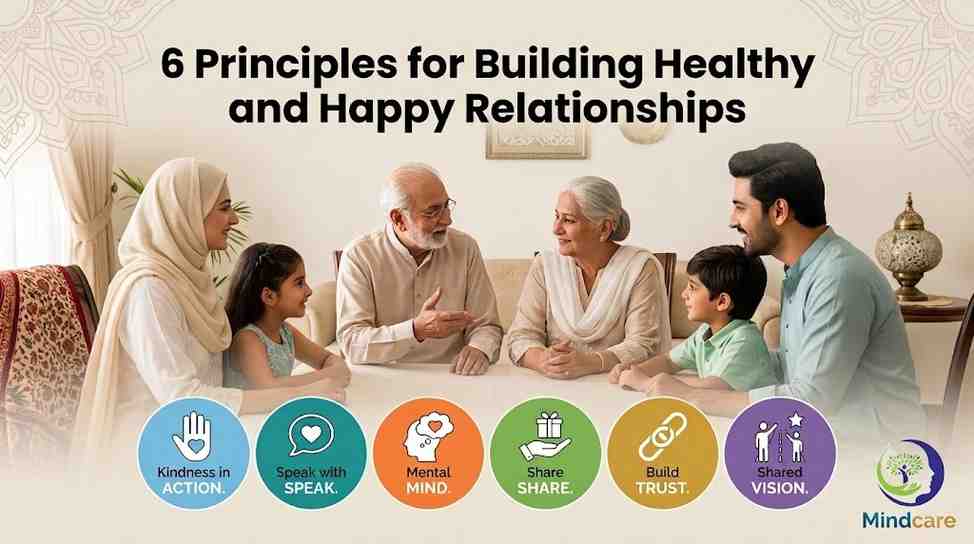
6 Principles for Building Healthy and Happy Relationships
A Psychology-Inspired Guide Enriched with Islamic Wisdom and Pakistani Family Values
Relationships are among life's greatest blessings. They bring us love, companionship, support, and a sense of belonging. Yet they can also become one of our greatest sources of stress and emotional pain.
Whether it's your spouse, parents, children, siblings, friends, or colleagues, every relationship requires continuous care, understanding, patience, and sincere effort. Many people believe lasting relationships depend on finding the "perfect" person.
In reality, healthy relationships are built through everyday habits, mutual respect, and conscious choices.
In Pakistan, family relationships form the foundation of our society. Our homes often include multiple generations living together, making love, patience, and effective communication even more important. Islam beautifully complements modern psychology
by teaching compassion, honesty, forgiveness, and kindness—qualities that strengthen every relationship.
Allah Almighty reminds us:
"And speak to people good words."
(Qur'an 2:83)
This simple command captures one of the greatest secrets of healthy relationships: our words and actions should bring peace rather than pain.
Let's explore six timeless principles that can help build stronger, healthier, and happier relationships.
Why Relationships Become Difficult
Have you ever caught yourself thinking:
- "Why can't they think like me?"
- "Why don't they understand me?"
- "Why can't they change?"
These thoughts are surprisingly common.
One of the biggest mistakes we make in relationships is expecting others to think, feel, and react exactly as we do.
But every person has lived a different life. People grow up in different families, experience different hardships, develop different personalities, and express emotions in different ways.
In Pakistani households, for example, one family member may value open conversations while another believes silence is a sign of respect. One spouse may express love through words, while the other expresses it through responsibilities and sacrifice.
These differences are natural—not signs that someone is wrong. When these differences remain unaddressed, however, they can grow into ongoing tension—we've written more about dealing with relationship stress in Pakistani families.
Allah says:
"Among His signs is the creation of the heavens and the earth and the diversity of your languages and your colors. Surely in that are signs for people of knowledge."
(Qur'an 30:22)
Just as Allah created us physically different, He also created us with different personalities, talents, and emotional needs.
Healthy relationships begin with one powerful mindset:
Understand before you expect.
Instead of asking, "Why aren't they like me?" ask,
"What experiences have shaped them into who they are?"
Understanding creates empathy, and empathy opens the door to harmony.
1. Show Kindness Through Your Actions
Love is not measured only by words—it is demonstrated through actions.
Acts of kindness do not require expensive gifts or grand romantic gestures. More often, love is expressed through small daily actions that say,
"I care about you."
These simple acts may include:
- Helping with household chores
- Supporting your spouse during stressful times
- Helping elderly parents with daily tasks
These everyday gestures are especially meaningful in Pakistani families, where responsibilities are often shared across generations.
The Prophet Muhammad ﷺ set the greatest example. Despite being the leader of the Muslim community, he helped with household work.
He said:
"The best of you are those who are best to their families, and I am the best among you to my family."
(Jami' at-Tirmidhi)
Modern psychology agrees that consistent acts of service build emotional security and strengthen trust far more than occasional grand gestures.
Small acts performed regularly often leave the deepest impact.
2. Speak with Kindness
Words can heal—or they can leave emotional wounds that last for years.
Many relationships slowly weaken because people become polite to strangers but harsh toward those they love the most.
Healthy communication means choosing words that communicate: Respect, Appreciation, Encouragement, Patience, Compassion
Simple phrases such as:
- "I'm proud of you."
- "I appreciate everything you do."
can completely change the emotional atmosphere of a home.
In Pakistani culture, elders often remind us that "Meethi zubaan dil jeet leti hai" (A gentle tongue wins hearts). This timeless wisdom aligns perfectly with both psychology and Islam.
Kind words cost nothing—but they can mean everything.
3. Cultivate Mental Kindness
Every relationship begins in the mind before it appears in our words and actions.
Our thoughts shape our emotions.
Our emotions shape our behavior.
If our minds are constantly filled with criticism, resentment, suspicion, or unrealistic expectations, kindness becomes difficult.
Instead, practice asking yourself:
- What might they be going through?
- Could I be misunderstanding the situation?
- Am I assuming the worst?
Many family conflicts begin because we assume intentions instead of asking questions.
Psychologists call this the fundamental attribution error—we often judge others by their mistakes while excusing our own because we know our intentions.
Replacing judgment with curiosity creates emotional safety and deeper understanding.
4. Learn to Share Generously
Healthy relationships thrive through giving rather than keeping score.
Sharing is not limited to money.
You can generously share:
- Your time, Your attention, Your knowledge, Your food, Your opportunities, Your encouragement, Your happiness
Imagine enjoying a delicious meal while travelling.
Instead of simply saying, "I had a great lunch," you bring home dessert for your family or recommend the restaurant to a loved one.
That simple gesture communicates:
"I thought about you even when you weren't with me."
The Prophet ﷺ taught:
"None of you truly believes until he loves for his brother what he loves for himself."
(Sahih al-Bukhari & Sahih Muslim)
Pakistani culture beautifully reflects this value. Whether it's sending food to neighbors during Ramadan, sharing homemade dishes with relatives, or welcoming guests with generosity, these traditions strengthen emotional bonds and foster a sense
of belonging.
Generosity makes people feel remembered, valued, and included.
5. Build Trust Through Integrity
Trust is the foundation of every healthy relationship.
Without trust, even love struggles to survive.
Trust grows through everyday consistency:
- Being honest
- Keeping promises
- Respecting boundaries
- Remaining loyal
- Admitting mistakes
- Following through on commitments
Trust is not built in a single moment. It grows through hundreds of small interactions where our actions consistently match our words.
Once broken, trust can often be repaired—but it requires patience, sincerity, accountability, and time.
6. Work Toward a Shared Vision
Strong relationships become even stronger when people move in the same direction.
Every healthy family benefits from shared goals.
These may include:
- Raising children with good character
- Building financial stability
- Supporting each other's careers
- Growing spiritually
- Caring for ageing parents
- Maintaining physical and mental well-being
- Creating a peaceful home
Rather than seeing yourselves as opponents during disagreements, remember that you are teammates working toward the same future.
Allah says:
"Help one another in righteousness and piety."
(Qur'an 5:2)
For Muslim families, the strongest shared vision is seeking the pleasure of Allah together. Couples who pray for one another, encourage good deeds, and support each other's personal growth often develop resilience that helps them navigate life's
inevitable challenges.
Understanding Comes Before Harmony
Many relationship problems begin when we expect people to think exactly like us.
Real harmony begins when we replace expectations with understanding.
Instead of trying to change someone, try understanding:
- Their upbringing
- Their personality
- Their fears
- Their emotional needs
- Their communication style
Empathy transforms frustration into compassion.
No relationship can survive without forgiveness.
Allah beautifully reminds us:
"Let them pardon and overlook. Would you not love that Allah should forgive you?"
(Qur'an 24:22)
Forgiveness does not mean ignoring harmful behavior. Rather, it means choosing healing over bitterness whenever reconciliation is possible. In fact, forgiveness is the key to happiness and better relationships.
Final Thoughts
No relationship is perfect.
Every family experiences misunderstandings, disagreements, and difficult seasons. What separates healthy relationships from unhealthy ones is not the absence of conflict but the willingness to face challenges with patience, honesty, kindness,
and mutual respect.
The Prophet Muhammad ﷺ said:
"The most perfect of the believers in faith are those with the best character."
(Jami' at-Tirmidhi)
Good character is reflected in the way we treat those closest to us—especially when life becomes difficult.
Rather than waiting for others to change, begin by changing your own habits. Offer a kind word, perform a thoughtful act, listen without judgment, forgive sincerely, and strive to become someone who brings peace into the lives of others.
Strong relationships are not built overnight. They are nurtured through countless small moments of compassion, trust, generosity, and understanding.
In the end, lasting relationships are not built on perfection—they are built on mercy, respect, sincerity, and a shared commitment to grow together for the sake of Allah.
And when relationship challenges feel too heavy to resolve alone, seeking help is a sign of wisdom, not weakness. You can speak privately with an online psychologist in Pakistan from the comfort of your home—book an online therapy session to take the first step.
A Gentle Reminder
The strongest homes are not those where disagreements never happen. They are the homes where family members choose kindness over harshness, understanding over assumptions, forgiveness over resentment, and love over ego.
May Allah grant our families love, mercy, patience, and lasting peace. Ameen.