
MindCare Pakistan offers convenient and affordable online therapy, connecting you with licensed therapists from the comfort of your own home. Find support for anxiety, depression, relationships, and more.

Connect with a qualified psychologist online from the convenience of your home in Pakistan.

Book Appointment
Address

Islamabad, Pakistan
A Better Conversation Can Change the Pattern

Online Relationship & Couples Therapy

Understand What Keeps Going Wrong—Not Just Who Is Right.

Relationship difficulties often become repetitive. The topic may change, but the same cycle returns: one person feels unheard, the other feels criticised, tension rises, and both leave the conversation feeling further apart.

Relationship therapy provides a structured space to understand these patterns, communicate more clearly, and work on trust, closeness, boundaries, or difficult decisions with professional support.

Book an Appointment
✓ Private Online Sessions✓ Professional Psychological Support✓ Accessible Wherever You Are
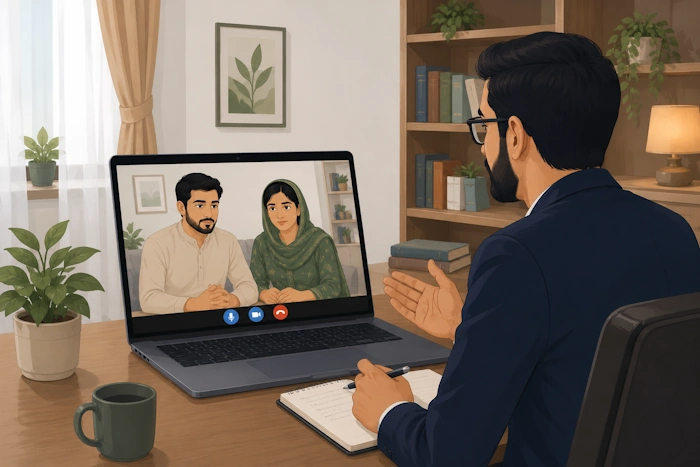
Couple attending online relationship therapy with a psychologist
When the Same Conflict Keeps Returning

Relationship Problems Often Develop as a Cycle

Couples can become stuck in patterns where each person's reaction unintentionally triggers the other's. Therapy looks at the interaction between you rather than simply deciding which person is “the problem.”

Something Feels Wrong

A disagreement, unmet need, criticism, family issue, or old hurt creates tension.

The Reaction Escalates

One person may pursue, criticise, become angry, defend themselves, withdraw, or shut down.

The Pattern Repeats

The original issue remains unresolved and similar conversations begin producing the same outcome.

Distance Grows

Over time, resentment, mistrust, loneliness, or emotional distance can become part of the relationship.

Reasons People Seek Support

You Don't Need to Wait Until a Relationship Is at Breaking Point

Some couples seek therapy during a crisis. Others come because a relationship that matters to them has gradually become more difficult, distant, or repetitive. Seeking support earlier can provide space to understand what is happening before patterns become even more entrenched.

  • Recurring arguments that never seem fully resolved
  • Communication that quickly becomes defensive or hostile
  • Emotional distance, loneliness, or loss of connection
  • Trust concerns, secrecy, betrayal, or the aftermath of infidelity
  • Differences around family, parenting, finances, boundaries, or priorities
  • Difficulty making an important decision about the relationship

“We Talk, But We Don't Feel Heard.”

Communication problems are rarely only about finding better words. What each person hears can be shaped by past arguments, expectations, fears, and assumptions about what the other person means.

“We Keep Having the Same Argument.”

Therapy can slow the interaction down enough to identify what repeatedly triggers the cycle and what each person does when they feel hurt, threatened, ignored, or misunderstood.

“We Care About Each Other, But We Feel Far Apart.”

Relationship therapy can also explore emotional closeness, affection, intimacy, shared expectations, and the experiences that may have gradually created distance.

Inside the Therapy Room

Relationship Therapy Is Not a Courtroom

The psychologist's role is not to choose a winner, prove that one partner is right, or force two people to remain together. Therapy aims to create a structured environment where important issues can be examined more clearly and each person's perspective can be understood.

Both people may be encouraged to notice not only what they want the other person to change, but also how their own reactions contribute to the pattern between them.

What You May Work On Together

  • Communication: expressing needs and concerns more clearly while listening with greater understanding.
  • Conflict patterns: recognising escalation, defensiveness, criticism, withdrawal, or other recurring responses.
  • Trust: understanding what has damaged trust and what rebuilding it may realistically require.
  • Connection: exploring emotional distance, affection, intimacy, companionship, and shared expectations.
  • Boundaries: discussing family involvement, privacy, responsibilities, finances, parenting, or other areas of tension.
  • Decisions: creating space for difficult conversations when the future of the relationship feels uncertain.
Your First Session

What Happens When You Start Couples Therapy?

Your psychologist will usually want to understand what brings you to therapy, how each of you sees the problem, important relationship history, recurring areas of conflict, and what you hope might change.

It is normal for two people to describe the same relationship very differently. Those differences are useful information rather than something that must be resolved immediately. The therapist can help identify the interaction patterns underneath the individual versions of events.

Depending on your needs and the psychologist's approach, therapy may draw on evidence-informed couples and relationship approaches, communication work, behavioural strategies, emotion-focused work, or other appropriate psychological methods.

Do Both Partners Have to Attend?

Couples therapy generally involves both partners when the goal is to work directly on the relationship. However, an individual may also seek psychological support for relationship difficulties when a partner does not want to attend or when the focus is on their own decisions, boundaries, reactions, or well-being.

The appropriate format depends on the concern and should be discussed with the psychologist.

Pakistani Relationships Have Their Own Context

When a Relationship Includes More Than Two People

For many Pakistani couples, relationship decisions exist within a wider family and cultural system. Expectations involving parents, in-laws, finances, living arrangements, children, privacy, gender roles, or marriage responsibilities can become deeply connected with conflict between partners.

For Pakistanis living abroad, migration and cultural adjustment may add another layer—particularly when partners have different expectations about family involvement, independence, parenting, or maintaining cultural traditions.

Therapy Can Make Space for Context Without Making Assumptions

A culturally informed approach does not assume that every Pakistani couple has the same values or family structure. Instead, therapy can explore which expectations actually matter in your relationship and where differences are creating pressure.

  • Boundaries and involvement of extended family or in-laws
  • Different expectations about marriage and responsibilities
  • Parenting disagreements and intergenerational differences
  • Balancing individual needs with family obligations
  • Challenges faced by couples living across cultures or countries

You Don't Have to Solve the Same Argument One More Time on Your Own

A structured conversation with a psychologist can help you understand the pattern and decide what needs to change.

An Important Safety Consideration

Couples Therapy Is Not Appropriate for Every Situation

When there is fear, coercive control, threats, or violence in a relationship, standard joint couples therapy may not be appropriate or safe. A private individual assessment can help determine what kind of support is more suitable.

If you are unsure whether joint sessions are appropriate for your circumstances, discuss this privately with a qualified professional before beginning couples work.

Confidentiality in Couples Therapy

Therapy is handled with professional confidentiality, subject to applicable ethical, legal, and safety limits. Because couples therapy involves more than one client, it is also useful to ask your psychologist how confidentiality, individual disclosures, and any separate conversations are handled within their practice.

FAQ & Answers

Common Questions About Relationship & Couples Therapy

No. Relationship therapy may be relevant for married couples, engaged partners, or other committed couples depending on the concern and the psychologist's scope of practice. Individual therapy can also address relationship difficulties when only one person is seeking support.

Therapy cannot guarantee that a couple will stay together. It can help you understand recurring patterns, communicate more clearly, work on specific difficulties, and make more informed decisions about the relationship.

You can still seek individual psychological support to explore your own reactions, boundaries, communication, decisions, and well-being. Individual therapy is different from couples therapy because the relationship itself is not being treated with both partners present.

The aim is not to declare one partner the winner. A couples therapist works to understand the relationship pattern and each person's experience while maintaining appropriate professional boundaries and addressing harmful behaviour when relevant.

In some circumstances, online sessions may be possible when partners are in different locations, depending on the psychologist's practice, professional requirements, privacy, technology, and where each person is physically located. Confirm suitability when booking.

There is no fixed number for every couple. The duration depends on the concerns involved, how long patterns have been present, your goals, engagement in therapy, and the approach being used. Progress and next steps can be reviewed with your psychologist.